The IP28 Mindset Is Alive and Well in Colorado’s Governor’s Orbit
Oregon’s IP28 failed. But the philosophy behind it is not some fringe idea confined to Portland. Colorado’s First Gentleman has been articulating many of the same moral premises for years — and his latest attack on the Right to Hunt and Fish makes the parallel difficult to ignore.

There it is again: cruelty.
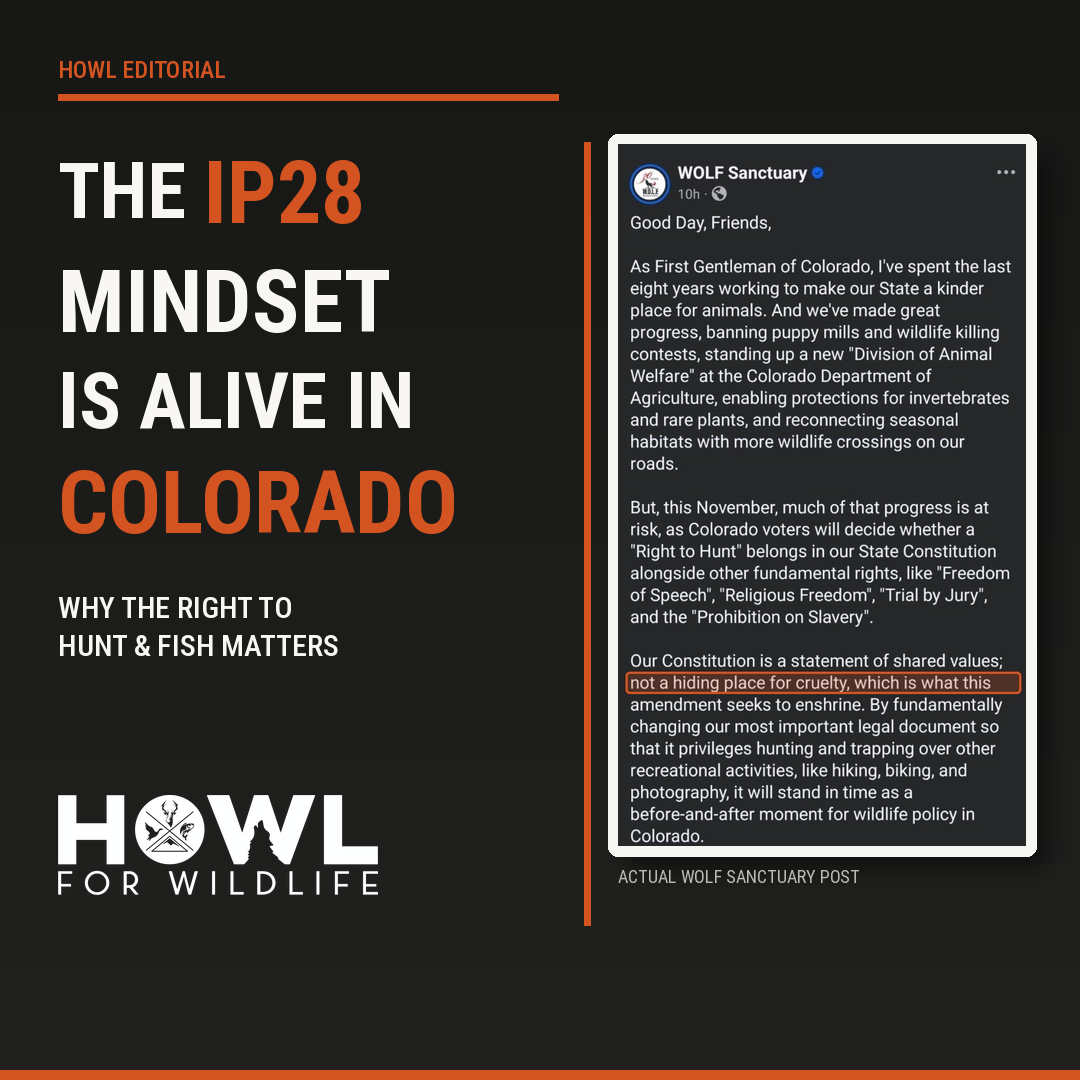
Colorado First Gentleman Marlon Reis recently argued against constitutionally protecting the Right to Hunt and Fish, writing:
“Our Constitution is a statement of shared values; not a hiding place for cruelty.”
That sentence deserves more attention than it is getting, because it tells us what this debate is increasingly about.
Not population objectives. Not bag limits. Not whether a particular hunting season is biologically sustainable. Not whether Colorado Parks and Wildlife got a management decision right or wrong.
More specifically, whether killing and using animals can be morally legitimate at all.
If you followed Oregon’s Initiative Petition 28, that should sound familiar.
Reis has been telling us what he believes
This is not a gotcha because Marlon Reis is vegan. What someone eats is their business, and plenty of people who do not hunt have no interest in taking hunting away from anyone else.
The important distinction is between animal welfare and animal rights.
Animal welfare asks how animals should be treated when humans interact with them. Hunters operate within that conversation all the time: ethics, fair chase, humane killing, habitat, population health, responsible use.
Animal-rights philosophy asks a more fundamental question: What right do humans have to use or intentionally kill animals in the first place?
Reis’s public record puts that question front and center.
In a 2019 interview, Mercy For Animals introduced Reis as a “vegan animal rights activist.” Reis explained that his path to veganism began when he started asking why cows should be treated differently from the pets sleeping at the foot of his bed. Eventually, he said, “I wanted to be 100 percent on the side of animals.” He also stated that “helping animals is my platform as first gentleman,” and described that work as encompassing domestic, wild and farmed animals.
That was not an offhand remark.
Later that year, the University of Denver’s Institute for Human-Animal Connection quoted Reis praising advocates who, “as a matter of morality,” believe animals deserve better and who are learning to make the case for laws protecting “all animals.”
Then there is lethal wildlife management.
When Denver used culling to manage an overabundant Canada goose population, Reis said large-scale lethal management needed to be challenged wherever it occurred. His prescription was clear: cities should “exhaust all non-lethal options before ever considering killing animals.”
During the fight over relocating prairie dogs to rural Colorado, Reis was even less delicate with people on the receiving end of those policies. He told critics:
“Colorado is more than ranchers, and it’s time to adapt rather than complain.”
You don’t have to guess at the worldview here. He has been remarkably candid about it.
Now meet IP28
Oregon’s IP28 was the third iteration of a proposal seeking to eliminate exemptions from animal-cruelty laws that allow hunting, fishing, livestock slaughter and other traditional uses of animals.
Its chief petitioner, David Michelson, explains the premise this way: dogs and cats receive legal protections from being intentionally harmed or killed, so why shouldn’t those protections extend to animals on farms, in laboratories and in the wild?
Under IP28, that meant moving away from slaughtering animals, hunting, fishing and animal testing. Michelson described a system in which killing animals is commonly used to meet human needs and then said plainly:
“We want to change that system.”
And here is the part hunters should tattoo onto their political memory.
The proponents knew IP28 was unlikely to pass.
That wasn’t the point.
Michelson acknowledged that most Oregonians were not ready for what IP28 proposed. The campaign viewed the effort as part of a much longer project to grow support and move public opinion toward its position. In another interview, he explained the strategy succinctly: “if we want to succeed in the future, it will help if we start asking for it now.”
IP28 ultimately failed to qualify for the 2026 ballot. It finished about 13,000 valid signatures short.
But look at the trajectory.
That is not a movement interpreting failure as a stop sign.
IP28 said the end game out loud
To be precise, I have found no evidence that Marlon Reis endorses IP28.
He does not need to.
The important thing is the philosophical architecture underneath both arguments.
Reis described questioning why a cow should be morally different from a beloved pet.
IP28 begins by asking why farm animals and wildlife should receive different legal protections from dogs and cats.
Reis has advocated exhausting nonlethal options before killing wildlife.
IP28 proposes taking lethal wildlife management off the table.
Reis has spoken of protecting “all animals” and approaches the issue explicitly as a matter of morality.
IP28 asks society to reconsider whether humans should kill animals to satisfy human needs.
And now Reis describes constitutional protection for hunting as a “hiding place for cruelty.”
Same legislation? No.
Same destination tomorrow? We cannot know.
Look at the logos. Then read the words.

No, these logos do not prove the organizations are connected, and I am not suggesting they do.
But come on.
The visual similarity is almost comical: animals arranged around a circular identity mark, one belonging to a University of Denver institute that calls Reis an ally, the other to Michelson’s IP28 campaign.
More important than the logos is what sits underneath them.
Reis asks why a cow should be morally different from the pet sleeping at the foot of your bed.
Michelson asks why the legal protections afforded dogs and cats should not extend to farm animals and wildlife.
And that is the point of this entire article.
You do not need a secret meeting, an organizational flowchart or a direct Reis-Michelson connection to recognize an ideology when its advocates keep describing it in remarkably similar terms.
Colorado’s version wears a nicer suit
This is where people make a mistake with IP28.
They look at the finished product and laugh.
Ban hunting? Ban fishing? Criminalize livestock slaughter?
Come on. Nobody is going to vote for that.
IP28’s own proponents essentially agree — today.
But movements like this do not begin with the finished product.
They begin by changing the moral vocabulary.
Killing becomes cruelty.
Use becomes exploitation.
Management becomes domination.
An elk, a dairy cow and the golden retriever sleeping on your couch gradually become morally interchangeable.
The individual animal becomes the primary unit of concern, rather than populations, ecosystems and the sometimes messy realities of wildlife management.
None of this requires sinister people plotting in a dark room. In fact, that caricature makes the movement harder to understand.
Many of these advocates sincerely believe they are making the world kinder.
That is precisely why hunters should take them seriously.
Good intentions are perfectly capable of producing terrible wildlife policy.
The difference between conservation and preservation matters
Modern wildlife conservation does not begin with the premise that an animal must never die.
Nature certainly doesn’t.
Animals die from predation, starvation, disease, competition, injury, exposure and old age. Predator eats prey. Populations expand and contract. Habitat changes. Carrying capacity exists whether we find it emotionally satisfying or not.
Conservation asks how people can participate responsibly in that system while maintaining healthy wildlife populations and functioning ecosystems.
That is fundamentally different from a philosophy in which avoiding harm to each individual animal becomes the overriding objective.
Colorado saw that tension on display in 2025 when Reis hosted a discussion on wolves at the Governor’s Residence featuring proponents of “compassionate conservation,” an approach that places substantial emphasis on the welfare and intrinsic value of individual sentient animals. The event included arguments for nonlethal management and the proposition that individual wolves possess a right to live.
Go ahead, debate those philosophies.
It is not, however, the same philosophy that built the North American system of wildlife conservation.
And Coloradans deserve to understand the difference.
Which is exactly why the Right to Hunt and Fish matters
The case for Colorado’s constitutional Right to Hunt and Fish is not that hunting will disappear next Tuesday.
Nobody is confiscating fishing poles at the state line.
The case is much simpler:
IP28 is a flashing neon example.
Its proponents did not wake up one morning and invent an alien ideology from scratch. They took ideas already circulating through the animal-rights movement — about cruelty, killing, animal autonomy and mankind’s moral authority to use animals — and followed them farther down the road.
That is precisely the line Colorado needs to draw.
A Right to Hunt and Fish does not mean wildlife management stops.
Colorado’s proposal expressly preserves the authority of the Parks and Wildlife Commission and General Assembly to regulate hunting, fishing and wildlife management. State fiscal analysts likewise say CPW would continue setting and enforcing hunting and fishing regulations.
Seasons can change.
Bag limits can change.
Methods can be regulated.
Populations fluctuate. Science advances. Disease appears. Habitat changes.
That is wildlife management.
But there is an enormous difference between debating how hunting should be managed and deciding that hunting itself is morally illegitimate.
A constitutional right helps protect that distinction.
It says hunting and fishing are legitimate human activities that Colorado may responsibly regulate — not cultural leftovers waiting for a future political majority to redefine them as cruelty.
Believe people when they tell you what they believe
For generations, hunters and anglers could largely take the legitimacy of hunting and fishing for granted.
We cannot anymore.
When the First Gentleman of Colorado tells us that protecting hunting in the Constitution creates a “hiding place for cruelty,” we should not wave it away as overheated Facebook rhetoric.
We should listen.
When animal-rights activists tell us they want laws protecting all animals, we should listen.
When IP28 proponents tell us they know voters are not ready yet, but they intend to keep pushing until public opinion moves, we should listen.
They are telling us exactly what the long game looks like.
The question is whether hunters, anglers and conservationists are willing to play one of our own.
Colorado’s Right to Hunt and Fish is not about freezing wildlife management in amber. It is about keeping hunting and fishing within the framework where they belong: science, conservation, regulation, responsibility and sustainable use — rather than moral prohibition.
You do not have to hunt to understand why that matters.
You do not have to enjoy killing an animal.
You do not even have to personally like hunting.
You only have to recognize that wildlife policy built on the premise that killing equals cruelty leads someplace very different from wildlife policy built on science-based conservation.
Oregon gave us a glimpse of where that road can end.
Colorado is being given the opportunity to choose its road now.
IP28 failed. The mindset didn’t.
Protect the Right to Hunt and Fish in Colorado.