Act Now: Stop Political Interference in Washington’s Wolf Management
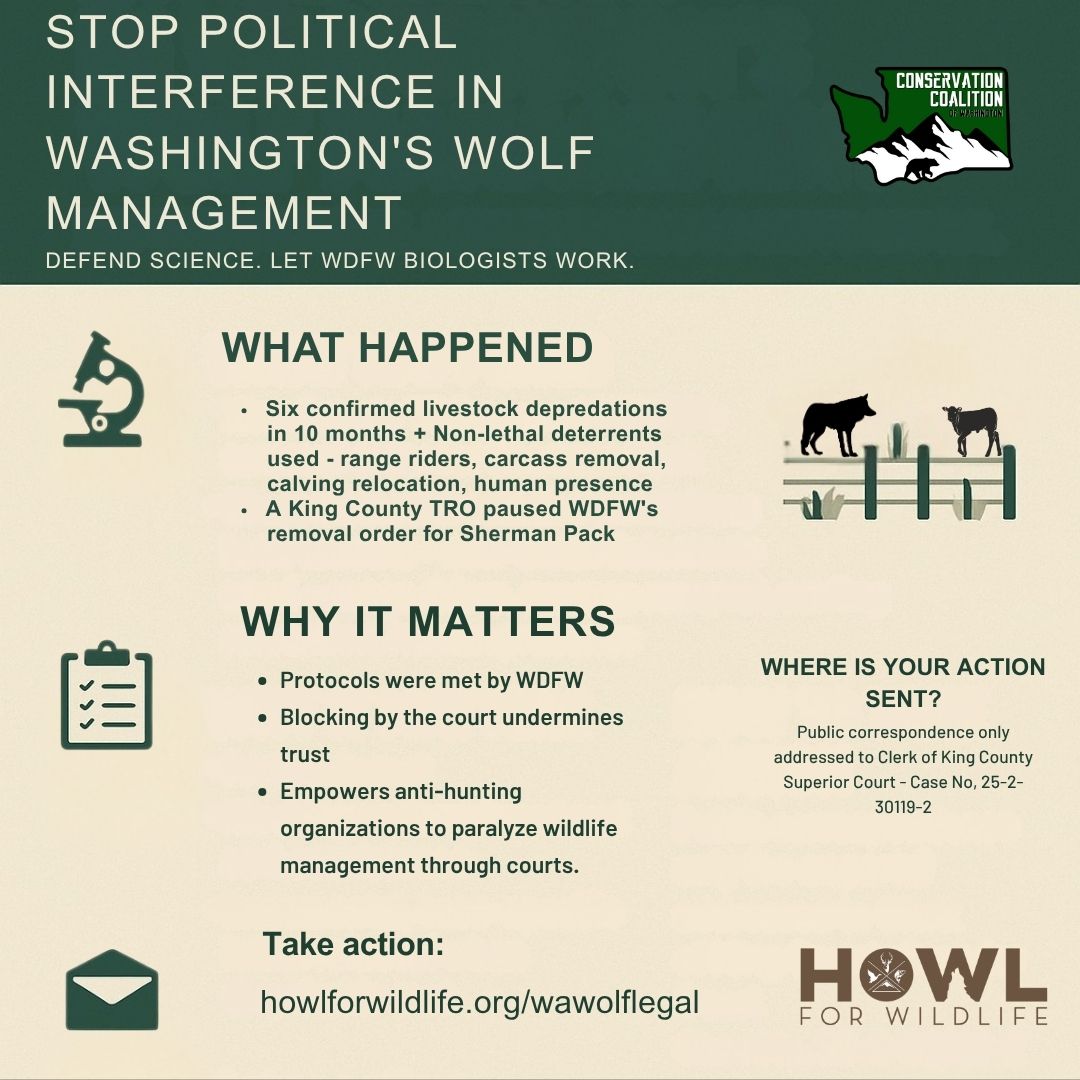
A King County Superior Court commissioner granted a temporary restraining order (TRO) on Oct. 14, 2025, blocking WDFW’s lethal-removal authorization for the Sherman Pack in Ferry County. WDFW documented six confirmed depredations in ten months despite extensive non-lethal deterrents and acted under the Wolf-Livestock Interaction Protocol, which allows lethal removal after 3 depredations in 30 days or 4 in 10 months (with non-lethal efforts documented). A preliminary-injunction hearing is set for Oct. 28, 2025. Conservation Northwest
The ask: lift the injunction so WDFW can follow its science-based plan and reduce conflict for both wolves and rural communities. WDFW
As a result of a lawsuit from the anti-hunting group Washington Wildlife First, a King County commissioner stepped in to halt the removal — overriding state wildlife experts and ignoring the department’s clear legal authority and scientific process.
This move is more than a local court decision — it’s a dangerous precedent. It allows political activism and urban ideology to overrule science, fieldwork, and the professional judgment of WDFW’s wildlife managers. It’s another version of “ballot box biology” — where decisions about wildlife are driven by emotion and lawsuits instead of data and expertise.
If allowed to stand, this injunction will:
• Undermine WDFW’s authority to manage wildlife under state law.
• Erode public confidence in science-based conservation.
• Empower anti-hunting organizations to paralyze wildlife management through courts.
• Harm both wolves and rural communities, making coexistence harder and conflict worse.
Quick fact sheet
-
What happened? On Oct. 14, a King County Superior Court commissioner issued a TRO preventing WDFW from removing a wolf from the Sherman Pack; the PI hearing is scheduled for Oct. 28. WDFW
-
Why was removal authorized? WDFW verified six depredation events within 10 months (seven livestock affected) after extensive non-lethal tools were used (range riders, etc.). WDFW
-
What’s the protocol threshold? Lethal removal may be considered at 3 depredations/30 days (acute) or 4/10 months (chronic) with non-lethal measures documented. WDFW
-
Who manages wildlife? RCW Title 77 charges WDFW/Commission to “preserve, protect, perpetuate, and manage” wildlife—agency expertise exists for a reason. Washington State Legislature
-
Why it matters: Blocking protocol-driven actions undermines trust, hurts coexistence, and can reduce public tolerance for wolf recovery. WDFW
FAQ
Did WDFW actually meet the threshold?
Yes. WDFW reported six depredations within ten months, with documented non-lethal efforts. That exceeds the “chronic” threshold (≥4/10 months) and also aligns with the “acute” framework (≥3/30 days) when applicable. WDFW
Why is a King County court involved in a Ferry County issue?
Petitioners filed in King County Superior Court; a commissioner granted a TRO on Oct. 14, 2025, with a preliminary-injunction hearing set for Oct. 28. Venue aside, the effect is to halt WDFW’s protocol-driven management statewide. WDFW
Does lethal removal undermine wolf recovery?
No. The protocol authorizes incremental, case-specific removal only after verified depredations and non-lethal tools fail. It’s designed to sustain recovery by maintaining public tolerance in working landscapes. WDFW
Washington’s wildlife must be managed by trained professionals, not by lawsuits, politics, or pressure campaigns. WDFW’s actions were consistent with state policy, scientific guidance, and the public interest.
Now is the time to stand up for science, conservation, and professional wildlife management.